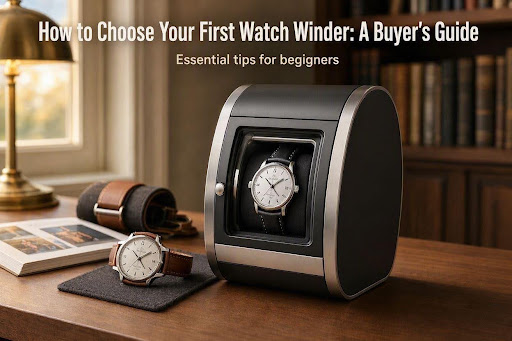
Buying your first automatic watch is a milestone. Buying your first watch winder is the moment you realise owning one properly takes a bit more thought than you expected.
A watch winder isn’t a luxury gadget for showing off on Instagram. It’s a practical tool that keeps a self-winding movement running, accurate, and ready to wear the second you pick it up. But walk into the market and you’ll find winders ranging from £30 to over £3,000, single-slot boxes sitting next to twelve-watch cabinets, and spec sheets full of terms like TPD, bidirectional rotation, and Japanese Mabuchi motors. For a first-time buyer, it’s easy to overspend on features you don’t need or underspend on a winder that damages the very watch it’s meant to protect.
This guide breaks down exactly what matters, what doesn’t, and how to pick a winder that fits your watch, your budget, and your daily routine.
Do You Actually Need a Watch Winder?
Here’s the short answer: you need one if you own an automatic watch with a complicated calendar function, or if you rotate between several automatics and don’t wear each one often enough to keep it wound.
Automatic watches wind themselves through the natural motion of your wrist. If you wear the same watch every day, it never fully stops, and a winder is optional. But the moment a watch sits in a drawer for more than two or three days, most movements run out of power reserve and stop. That’s a minor hassle for a simple three-hand watch. It’s a genuine chore for a watch with a perpetual calendar, moonphase, or annual calendar complication, where resetting the date and other functions after a stop can take several minutes of fiddly crown work, or in some cases requires a trip to a watchmaker.
If you own one automatic watch and wear it most days, save your money. If you’re building a small collection, travel often, or own anything with a complication worth protecting, a winder earns its keep quickly.
Single vs Multi-Watch Winders: How Many Slots Do You Need
This is usually the first decision buyers get wrong. They imagine their collection growing and buy a six-slot winder for two watches.
Buy for the collection you have now, plus one spare slot. A single or double winder suits most people starting out. If you already own four or five automatics you rotate between, a four-slot unit makes more sense than running two separate two-slot boxes.
Multi-watch winders also vary in how they run. Some rotate every watch simultaneously on a single motor and timer setting, which is fine if your watches all need similar rotation counts. Others give each slot an independent motor and its own programmable settings, which matters if your collection mixes brands with very different winding requirements. Independent settings cost more, but they’re the only sensible option once your watches need different treatment.
Understanding TPD and Rotation Direction
TPD stands for turns per day, and it’s the single most important spec on any winder. Every automatic movement has a manufacturer-recommended TPD range, and running a watch at the wrong setting either under-winds it or, more importantly, overwinds and adds unnecessary wear to the rotor and keyless works over time.
Most watches fall somewhere between 650 and 950 TPD, but the range is wide. A watch that needs 800 turns clockwise only will actually lose accuracy if you run it at 1,200 turns in both directions, because you’re feeding it far more energy than the mainspring and slipping clutch are designed to dissipate gracefully.
A decent winder lets you set:
- Turns per day (ideally adjustable in increments, not just a handful of presets)
- Rotation direction — clockwise, counter-clockwise, or bidirectional
- Rest intervals — pauses between winding cycles, which better replicate natural wrist movement and reduce motor wear
If you’re not sure what your watch needs, the manufacturer’s manual or website will list it. When in doubt, a bidirectional setting at a moderate TPD is a safe default for most brands.
Motor Type and Noise
This is the spec buyers skip and then regret. Cheap winders use basic DC motors that click audibly with every rotation. If the winder is going on your bedside table or in a bedroom cabinet, that click every few minutes becomes genuinely irritating at 2am.
Better winders use quieter stepper motors, often Japanese-made (Mabuchi is the common reference point), which run almost silently and rotate more smoothly. If you’re keeping the winder somewhere you’ll actually hear it — a bedroom, a home office, a shared living space — pay the extra for a quiet motor. It’s the difference between forgetting the winder exists and wanting to unplug it after a week.
Build Quality and Materials
A winder holds an expensive watch for weeks or months at a time, so the materials matter more than they might seem to at first glance. Look for:
- A solid wooden or metal outer case rather than thin plastic, which flexes and vibrates over time
- A cushion or pillow that fits your watch’s case size without stressing the clasp or bracelet
- A quiet, stable base that won’t creep across a shelf during operation
- A window or lid that protects the watch from dust while still displaying it
Cheaper winders often cut corners on the cushion first. An ill-fitting pillow puts pressure on the bracelet links or strap lugs in exactly the same spot for weeks, which is a slow way to damage a watch you’re trying to protect.
Budget vs Premium Winders: Where the Money Actually Goes
The price gap between a £40 winder and a £400 one isn’t just branding. It comes down to motor quality, programmability, and how well the unit protects the watch long-term rather than just spinning it. Aevitas’s Luxury Vs Budget Watch Winders breaks down exactly where that extra spend goes and when a budget option is genuinely good enough versus when it risks the watch it’s meant to care for.
As a rule of thumb: if your collection includes a watch worth more than the winder itself several times over, it’s worth spending more on the winder. Protecting a £3,000 watch with a £35 motor that overwinds it or vibrates excessively isn’t a saving, it’s a false economy.
Where to Keep Your Winder
A winder needs a stable, flat surface away from direct sunlight and away from strong magnetic sources like speakers or laptop chargers, both of which can affect a mechanical movement’s accuracy over time. A dresser, a dedicated watch cabinet, or a bedroom shelf all work well.
If you’re organising a growing collection alongside your winder, it’s worth thinking about the rest of your setup at the same time. Aevitas UK’s Valet Trays Organise Your Man range is designed to sit alongside a winder, giving watches you’re not currently winding, along with cufflinks, rings, and other everyday items, a proper home instead of a cluttered drawer.
Common Mistakes First-Time Buyers Make
Buying too many slots. Extra capacity sounds appealing until you’re paying for six motors and using two.
Ignoring TPD entirely. Running every watch on a generic default setting works most of the time, but it’s not optimal for movements at either end of the TPD range.
Choosing a winder based on looks alone. A beautiful case with a loud, cheap motor and a stiff cushion will disappoint within a month.
Skipping the warranty. Winders run motors continuously for months or years. A one-year warranty on the motor is a reasonable minimum; anything shorter is a warning sign about build quality.
Forgetting servicing needs. A winder doesn’t replace a proper service. Automatic movements still need periodic maintenance from a qualified watchmaker regardless of how they’re stored, and the British Horological Institute is a good starting point if you’re looking for accredited UK repairers or want to understand what a full service actually involves.
If you’re weighing up your first purchase and want to see how a properly specified winder compares to the basics covered here, it’s worth taking a look at Aevitas’s full range to find out more about the options built around real TPD accuracy and quiet motor performance rather than just a spinning box.
Final Thoughts
A watch winder is a small purchase that protects a much bigger one. Getting it right isn’t about spending the most money, it’s about matching the winder to your actual collection: the right number of slots, the correct TPD and rotation settings, a motor quiet enough to live with, and a build solid enough to hold an expensive watch safely for months at a time.
Start with what you own today rather than the collection you might have in five years. Check the TPD your watches actually need before assuming a default setting will do. And remember that a winder complements a watch’s maintenance schedule, it doesn’t replace it. Get those three things right, and your first winder will do exactly what it’s meant to: keep your automatic watches accurate, wound, and ready whenever you reach for them.
FAQs
Do watch winders damage automatic watches? A well-made winder set to the correct TPD and rotation direction won’t damage a watch. Damage usually comes from cheap motors, incorrect settings that overwind the mainspring, or ill-fitting cushions that stress the case or bracelet over time.
How many turns per day should a watch winder be set to? Most automatic movements need between 650 and 950 turns per day, but the exact figure varies by brand and calibre. Check your watch’s manual or manufacturer website for the recommended setting rather than relying on a generic default.
Can I leave my watch in a winder all the time? Yes, if the winder is correctly set for your movement. Many collectors leave watches winding continuously between wears, particularly watches with complications like a perpetual calendar that are inconvenient to reset.
Is a single watch winder worth buying if I only own one automatic watch? It depends on the watch. If it’s a simple three-hand automatic and you wear it most days, you probably don’t need one. If it has a complication that’s a hassle to reset, or you travel and leave it unworn for stretches, a single winder is a sensible investment.
What’s the difference between a cheap and an expensive watch winder? The main differences are motor quality and noise, the accuracy and range of TPD settings, cushion fit, and overall build quality. Cheaper winders often use louder motors and offer fewer or less precise settings, while premium models run quietly and protect the watch more consistently over long periods.